Roof repair
Roof flashing repair in Pembroke Pines, FL at walls and valleys
Most roof leaks start where the roof meets a wall, a valley or a vent pipe, and the metal flashing there has rusted, cracked or pulled loose.
- Open 24/7
- Based on Hiatus Road
- HVHZ-rated materials
- Real person on the line
- Visit booked on the same call
- Photos of what we find
Quick answer
Roof flashing repair replaces the metal pieces that seal joints and openings: valley metal, wall and step flashing, drip edge, pipe boots, and the pans around skylights and vents. Call when leaks appear near walls, chimneys or pipes. Typical South Florida flashing repairs cost $385 to $1,920. Call (754) 226-1055, answered 24/7.
Roof flashing repair around Pembroke Pines
On a tile roof, the tile sheds most of the rain, but the flashing and underlayment handle the joints where water concentrates. In Pembroke Pines, original galvanized flashing from the 1990s has often rusted through, and rubber boots on plumbing vents crack under strong sun. Where a second story wall meets a lower roof, missing kickout flashing sends water straight into the wall.
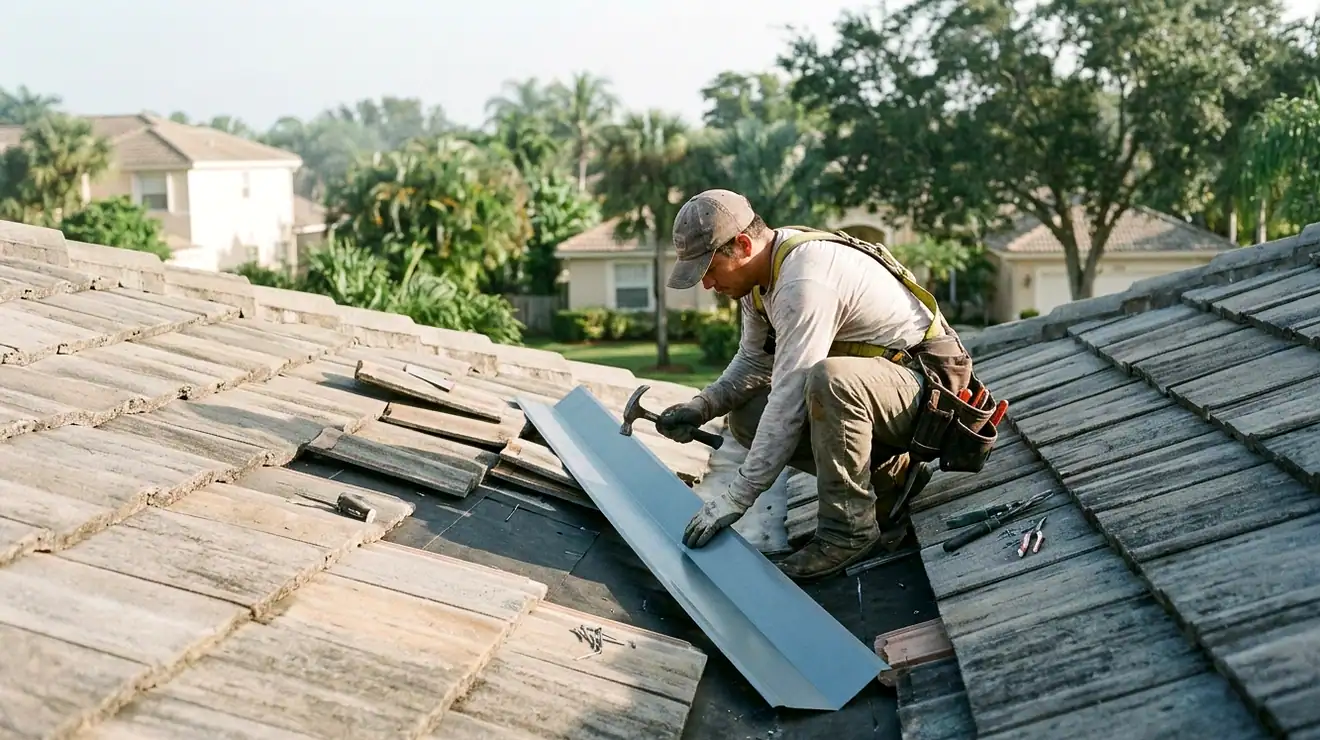
Flashing work usually means lifting tile or shingles along the joint, removing old metal, installing new underlayment, and fitting new flashing that laps correctly so water always runs over, never under. We use HVHZ approved metal and fasteners and form soft metal boots tightly around pipes. Good flashing should outlast the roof covering around it.
When to call
Signs it is time for roof flashing repair
Leaks near a wall
Stains on interior walls below the spot where a roof meets a higher wall usually point to failed wall or step flashing.
Rusted valley metal
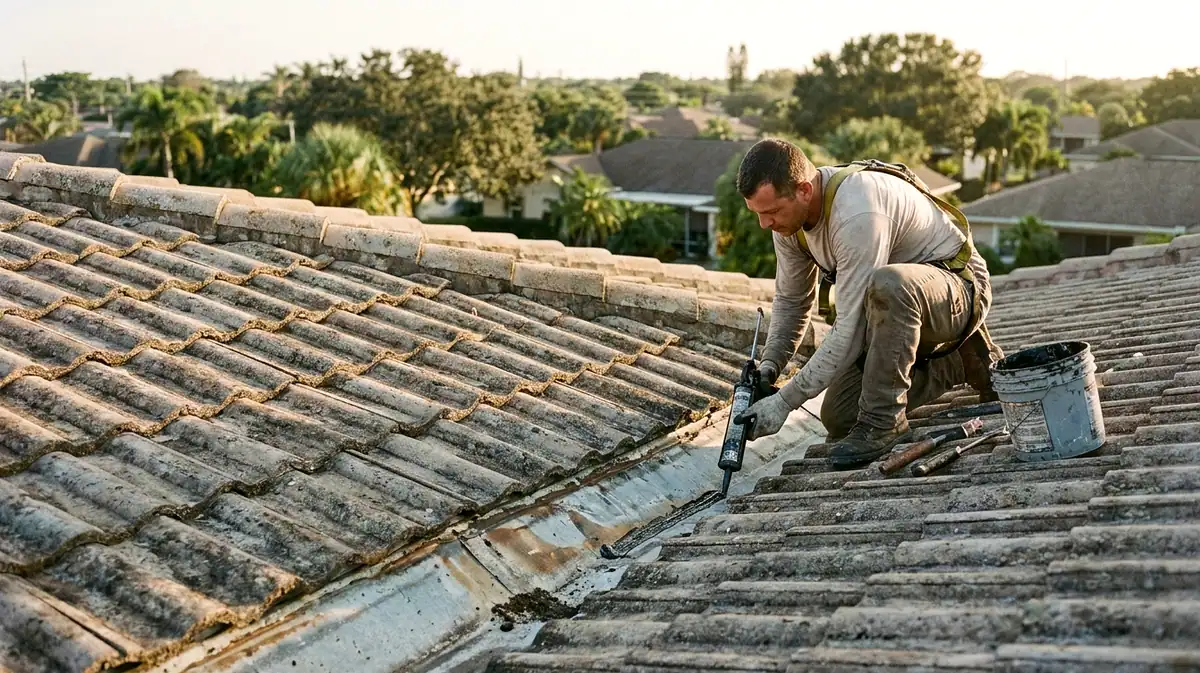
Valley metal that shows rust or holes when you look along it from a ladder will soon let water under the tile.
Cracked pipe boots
Rubber collars around plumbing vents split in the sun, leaving a ring gap where water runs straight down the pipe.
Stained stucco at roof line
Dark streaks or cracked stucco where a roof meets a wall often mean water is getting behind the stucco from above.
Loose drip edge
Drip edge that sags or pulls away at the eave lets water curl back onto the fascia and into the soffit.
Sealant as the only seal
Thick caulk smeared over flashing joints often hides an earlier failure and will crack and leak again within a year.
How the job runs
What happens on your roof
- 01
Locate every flashing point
We inspect valleys, walls, pipes, vents, skylights and chimneys, noting rust, gaps and short laps, and photograph each one.
- 02
Remove covering along the joint
Tile or shingles are carefully lifted along the flashing line and stacked for reuse, exposing the old metal and underlayment beneath.
- 03
Replace underlayment at the joint
Damaged underlayment is cut back and replaced with self-adhered underlayment that turns up the wall and runs under the new flashing correctly.
- 04
Install new flashing
New valley metal, wall flashing, kickout flashing or boots are fastened and lapped so water flows over each layer, using HVHZ approved materials.
- 05
Reset covering and seal
Tile or shingles are reinstalled with proper clearance from the flashing, the stucco stop is sealed where needed, and the joint is water tested.
Local factors that change this job
Concrete tile homes in Pembroke Pines from the 1980s to the 2000s commonly have original galvanized valley and wall flashing that has rusted after decades of humid air. Homes closer to the coast see faster corrosion from salt air. Under HVHZ rules, flashing metal gauge and fastening are specified, and drip edge must be installed with approved fasteners at set spacing. Where a roof meets stucco, a correctly lapped stucco stop or counter flashing keeps wind driven rain out of the wall.
Your options
Choices worth understanding first
Galvanized versus aluminum
Galvanized steel is strong but rusts as the coating wears. Aluminum resists corrosion in coastal air but must not touch dissimilar metals. We pick based on location and adjoining materials.
Soft metal pipe boots
Soft metal boots are formed tightly around plumbing vents and outlast rubber collars in South Florida sun. They are worked into the tile or shingle course for a clean seal.
Kickout flashing
A small diverter at the bottom of a roof to wall joint sends water into the gutter instead of behind the stucco. Many older homes were built without one.
Counter flashing at stucco
Counter flashing or a surface mounted reglet covers the top of the wall flashing, so water running down the stucco cannot get behind it.
Typical cost
What roof flashing repair costs in Pembroke Pines
| Soft metal pipe boot replacement | $385 to $690 |
| Valley metal replacement, per 10 feet | $740 to $1,920 |
| Wall flashing with stucco stop, per 10 feet | $620 to $1,480 |
| Drip edge replacement, per 20 feet | $295 to $615 |
Price depends on the length and type of flashing, how much tile or shingle must be lifted, the condition of the underlayment and decking at the joint, stucco work at walls, and roof height. A single pipe boot costs far less than a full valley rebuild. The final price is set after an on-roof look and shown to you in writing first. Compare every service on the roofing price guide.
Questions
Roof flashing repair questions we hear
Step flashing is a series of small L shaped pieces woven into each course of shingles along a wall. Tile roofs typically use continuous wall flashing with a pan that channels water down the slope. Both need counter flashing or a stucco stop above them so water running down the wall cannot get behind.
Valleys carry far more water than any other part of the roof, and leaves trapped there hold moisture against the metal. Older galvanized valley metal loses its zinc coating over time and starts to rust from the underside. The tile above can look perfect while the metal beneath it is thinning out.
Often, yes. Rubber boots typically fail years before the roof covering because UV cracks the rubber. On tile roofs we replace them with soft metal boots that last much longer. It is one of the most cost effective leak repairs you can make, and it is easy to do during any other roof work.
Sometimes. If the original flashing was installed with a surface mounted counter flashing, it can be replaced without touching the stucco. If the old flashing is buried behind the stucco, a narrow strip may need to be cut and patched afterward. We tell you which applies to your house before starting.
Related work
Often booked with this service
Roof Leak Repair
Water dripping into a bedroom during an afternoon downpour usually enters several feet from the stain, so patching the obvious spot rarely stops the leak for good.
See this serviceSecondary Water Barrier
When hurricane winds peel off shingles or crack tiles, rain pours through the bare plywood seams and soaks ceilings, insulation and drywall within minutes.
See this serviceTile Roof Repair
Cracked, slipped or loose tile leaves the underlayment open to sun and rain, and on a South Florida roof that exposed spot is where the next leak starts.
See this serviceMore roof repair services
- Roof Repair
- Leak Repair
- Tile Repair
- Shingle Repair
- Flat Roof Repair
- Metal Roof Repair
- Fascia & Soffit
- Skylights
- Mansard Repair
- Truss & Rafter Repair
Where we do this work most
Leak, storm damage or a roof that is simply getting old?
Call the roof line any hour. A real person answers, asks what you are seeing and sets the next step.