Hurricane hardening
Hurricane straps and roof-to-wall upgrades in Pembroke Pines, FL
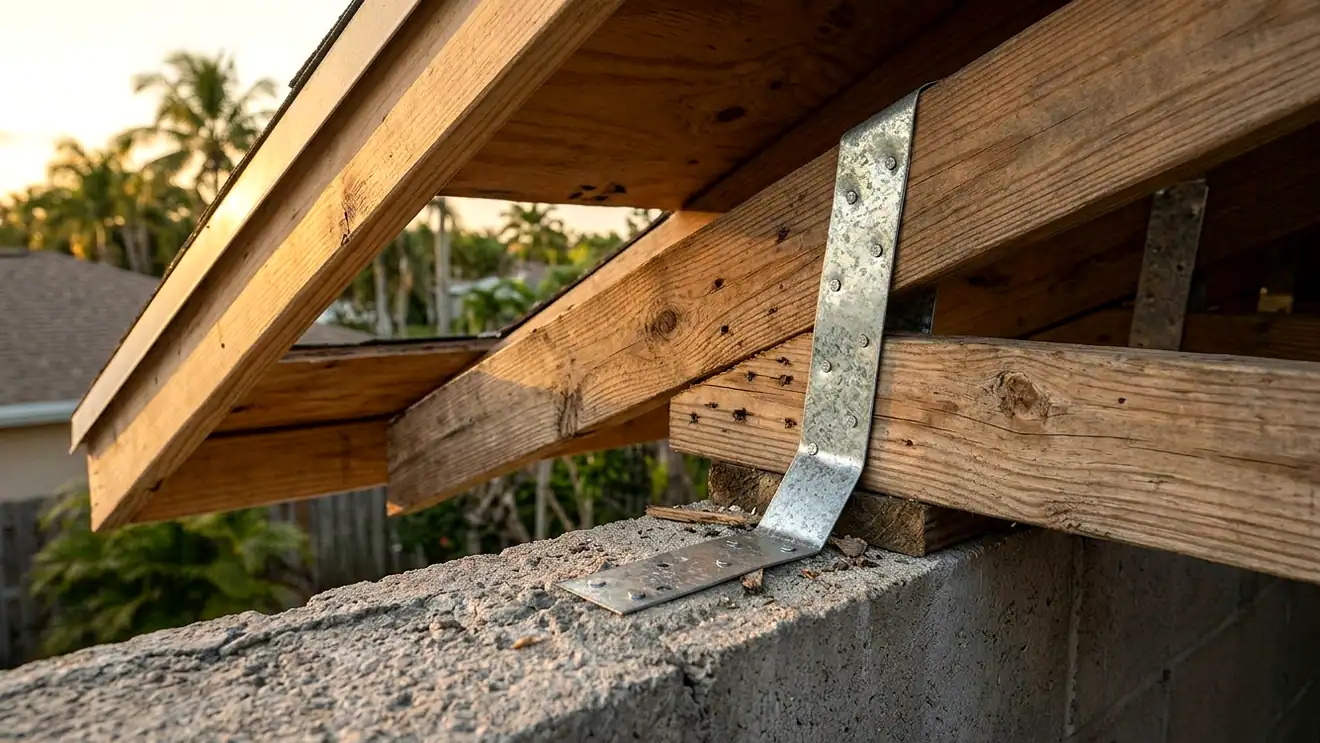
If your trusses are held to the walls only by angled toenails or a light clip, strong uplift can pull the whole roof frame off the house.
- Open 24/7
- Based on Hiatus Road
- HVHZ-rated materials
- Real person on the line
- Visit booked on the same call
- Photos of what we find
Quick answer
Roof-to-wall upgrades add metal hurricane straps or clips that tie each truss to the wall or tie beam below. Access usually comes from the eaves while the roof covering and edge sheathing are off during a reroof. Typical South Florida cost runs $1,370 to $4,850 depending on access and connector type. Call (754) 226-1055, answered 24/7, to have your connections checked.
Hurricane straps & roof-to-wall around Pembroke Pines
The roof deck can be nailed perfectly and still fail if the trusses under it are not tied down. Roof-to-wall connections carry uplift from the roof frame into the walls and foundation. In many South Florida homes that load path depends on nails driven at an angle through the truss into the top plate, which holds far less than a wrapped metal strap.
Concrete block homes across Pembroke Pines usually have a poured tie beam along the top of the walls, with straps or clips set into the concrete when the house was built. Some older homes have clips, some have straps that were never fully nailed, and some have neither. During a reroof the eave sheathing can be opened so each connection can be inspected and upgraded.
When to call
Signs it is time for hurricane straps & roof-to-wall
Toenails only at trusses
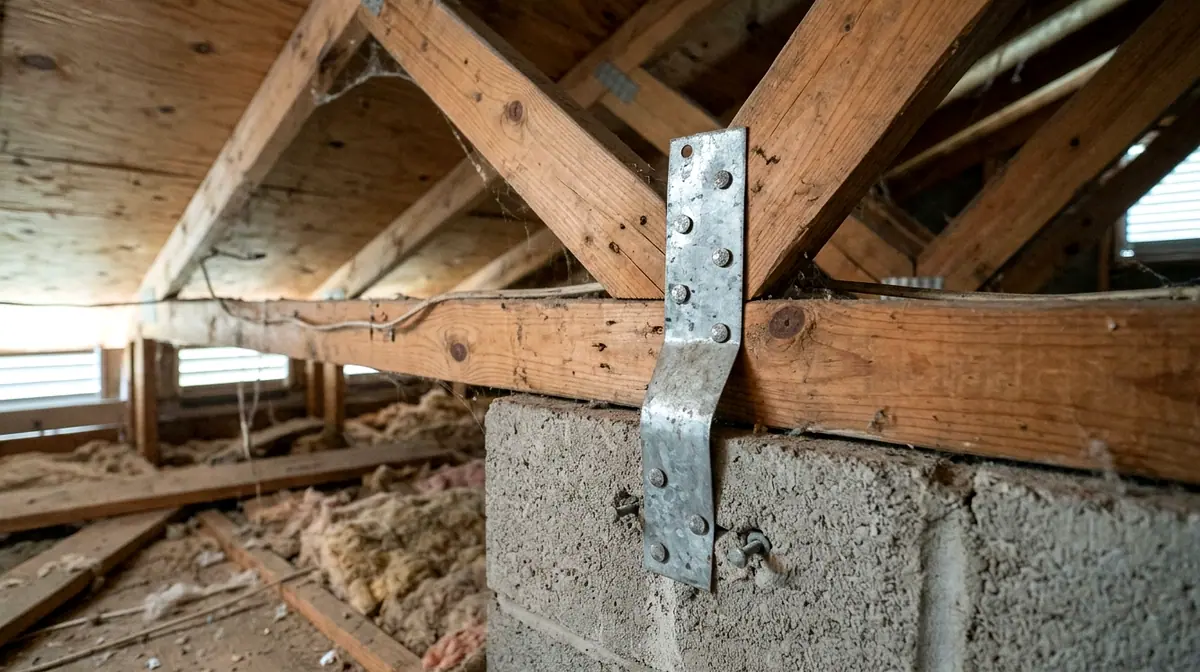
From the attic you see trusses resting on the wall with angled nails and no metal connector wrapping the joint.
Straps with empty holes
Connectors are present but several nail holes are empty, leaving each strap holding only a fraction of its rated load.
Rusted connectors
Metal straps near the eaves show heavy rust from attic moisture or old roof leaks, thinning the steel over time.
Report lists toe nails
Your wind mitigation report classified the roof-to-wall attachment as toe nails or marked the connection type as unverified.
Gable walls flexing
Gable end walls show cracks near the top or move in strong wind, a sign the end trusses lack bracing and ties.
Full reroof on the calendar
You are replacing the roof anyway, which gives the cleanest access to the eave line where connectors get installed.
How the job runs
What happens on your roof
- 01
Inspect from the attic
We check a sample of truss bearings from inside to see which connectors exist, how they are nailed and whether any are corroded.
- 02
Open the eave line
During tear-off the lowest course of sheathing is removed along the eaves so each truss bearing point can be reached from above.
- 03
Install approved connectors
Galvanized straps or clips rated for the location are wrapped over the truss and fastened into the concrete tie beam or wood top plate.
- 04
Fill every fastener hole
Each connector receives the full number of nails or anchors its manufacturer specifies, because a partly fastened strap loses much of its strength.
- 05
Close and photograph
Eave sheathing is replaced and re-nailed, and we photograph the connectors so your wind mitigation inspector can classify the roof-to-wall attachment.
Local factors that change this job
Most Pembroke Pines houses are concrete block with a tie beam, which makes strap retrofits more involved than on wood framed walls because anchors must go into concrete. Homes built from the late 1990s onward often already have embedded straps, so inspecting first avoids paying for work you do not need. Broward design wind speeds are among the highest in Florida, and the roof-to-wall category on the wind mitigation form reflects how well that load path is tied together.
Your options
Choices worth understanding first
Add clips at trusses
Clips fastened to the side of each truss and into the tie beam. The lighter upgrade, suitable when trusses bear cleanly on the wall and access is good.
Install double wrap straps
Straps wrap over the truss and fasten on both sides. When installed fully they hold the most uplift of the common connector types listed on the form.
Complete embedded straps
Where straps were cast into the tie beam but never fully nailed, we add the missing fasteners. Often the least expensive way to improve the connection.
Gable end bracing
Adds bracing and ties at gable end walls, which catch heavy wind pressure on many ranch style homes and are a common point of failure.
Typical cost
What hurricane straps & roof-to-wall costs in Pembroke Pines
| Completing embedded straps | $395 to $1,160 |
| New clips, average home | $1,370 to $2,640 |
| Double wrap straps, average home | $2,280 to $4,850 |
| Gable end bracing, per gable | $310 to $780 |
Cost depends on how many truss bearings need connectors, whether anchors go into concrete or wood, and how easily the eaves can be reached. Homes with embedded straps that only need nailing cost far less. Attic clearance near the outside walls also matters. The final price is set after an on-roof look and an attic check. Compare every service on the roofing price guide. Wondering where your roof sits on insurers’ age lists? Try the roof age check.
Questions
Hurricane straps & roof-to-wall questions we hear
Sometimes, from inside the attic, but reaching the bearing points at a low pitch eave is very difficult and many connectors cannot be wrapped properly that way. Working from above during a reroof, with the eave sheathing open, gives full access. We check from the attic first and tell you which method fits your home.
In block homes, trusses sit on a poured concrete tie beam. Connectors are nailed to the truss and fastened to the beam with concrete anchors, or they are straps that were cast into the concrete during construction. Many homes already have embedded straps that only need full nailing, which is why we inspect before pricing.
A clip fastens to the side of the truss only. A single wrap goes over the top of the truss and fastens on one side. A double wrap goes over and fastens on both sides. Each holds more uplift than the one before, and the wind mitigation form records which type your inspector finds.
Roof-to-wall attachment is its own category, and your wind mitigation inspector verifies it, usually from the attic. Stronger connectors can move a home to a better classification, though what that means for the wind portion of your premium depends on your insurer. We photograph each connector type to help the inspector.
Related work
Often booked with this service
Roof Deck Re-Nailing
Older roof decks were often fastened with staples or widely spaced smooth nails, so hurricane suction can lift whole plywood sheets right off the trusses.
See this serviceSecondary Water Barrier
When hurricane winds peel off shingles or crack tiles, rain pours through the bare plywood seams and soaks ceilings, insulation and drywall within minutes.
See this serviceRoof Replacement
Your roof is aging out, leaks keep coming back after each repair, or your insurer wants proof of remaining roof life before it will renew the policy.
See this serviceMore hurricane hardening services
Where we do this work most
Leak, storm damage or a roof that is simply getting old?
Call the roof line any hour. A real person answers, asks what you are seeing and sets the next step.